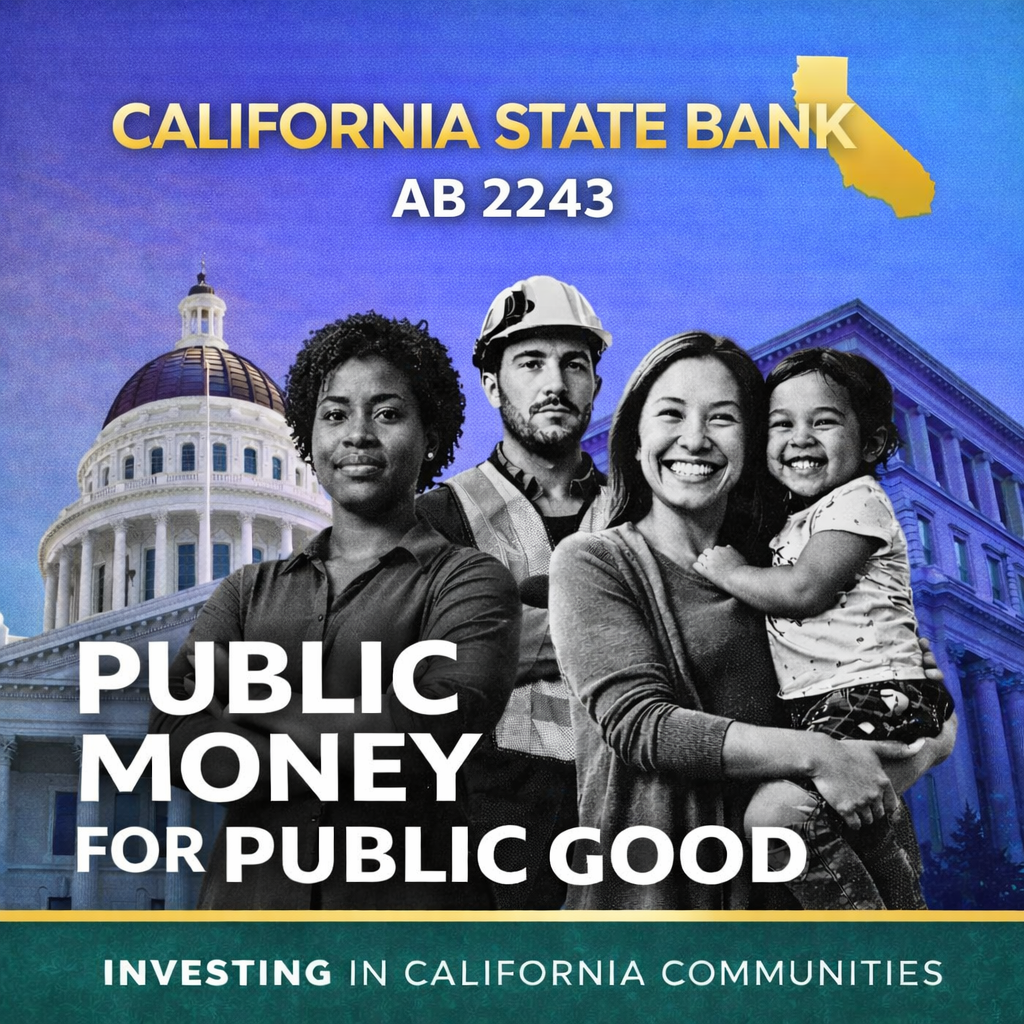
California State Bank (AB 2243)
Assemblymembers Matt Haney and Ash Kalra
Co-sponsors: California Public Banking Alliance, End Poverty in California (EPIC), The Greenlining Institute, Indivisible California: StateStrong, Sacramento Area Congregations Together (SacACT), 350 Sacramento, Friends of the Earth. Endorsed by 110+ organizations and growing.
AB 2243 creates an actionable State Bank Plan to design a state-owned depository bank that supports affordable housing, climate resilience, small businesses, and public infrastructure while saving taxpayer money at lower cost.
Why California Needs This Shift
California is facing a convergence of financial pressures. Local and state budgets are sliding into deficit, and the cost of borrowing to build keeps rising. California now pays $8 billion a year in debt service, and about half of that is interest – that’s roughly $4 billion annually of public dollars leaving the state instead of funding housing, infrastructure, or community needs. On a typical 30-year bond, we repay close to $2 for every $1 borrowed. The Governor’s January 2026 budget projects a nearly $3 billion shortfall in 2026–27.
At the same time, the state is short 1.54 million affordable rental homes for extremely low- and very low-income households, and financing to build new units or modernize infrastructure isn’t keeping pace. Federal support for housing, climate, and community investment has been cut, frozen, or delayed under the Trump administration, creating new volatility that makes it even harder for community lenders to keep small business and small-dollar credit flowing.
California relies on federal appropriations to run major housing, climate, and community programs. More than one-third of the state’s 2025–26 budget, about $175 billion, depends on federal funds, not counting funds that go directly to local governments and Community Development Financial Institutions (CDFIs). California sends more to Washington than it gets back, so delays or cuts in federal funding immediately strain state and local budgets.
A Practical Fix
Develop a State Bank Plan to determine how California can establish a state public bank to expand financing for housing, climate and energy, infrastructure, and small businesses. The plan will evaluate options modeled in part on the Bank of North Dakota, including whether a state depository bank should be established via conversion of an existing state entity. By coordinating currently fragmented financing tools, a state public bank could lower borrowing costs, expand lending capacity, and keep more public dollars working for Californians — without new taxes, long-term debt, or service cuts.
What Makes This Possible
A state bank equips CDFIs, credit unions, and community banks with the liquidity, guarantees, and participations they need to scale lending for critical public needs. It is a wholesale bank that backs local lenders, not a retail bank. It helps local governments by purchasing municipal notes and bonds to finance affordable housing and public infrastructure at lower costs.
California is the fourth-largest economy in the world, generating nearly $300 billion in public revenue each year. A state bank could begin with a small slice of that capital and, like any bank, leverage it up to 10 times. That means every $1 placed in the state bank can support up to $10 in lending. $1M can support up to $10M, creating a multiplier for what public dollars can do for California’s most urgent needs.
Action Plan – California State Bank
AB 2243 authorizes California to begin designing a state public bank through a State Bank Commission and an independent State Bank Plan, before any deposits move or new lending authorities are activated.
Phase 1 (AB 2243 – Planning Phase): Establish the State Bank Commission and develop the State Bank Plan
- Extend the sunset of the California Public Banking Act (AB 857) to maintain the state’s municipal public bank framework.
- Establish a 9-member State Bank Commission: Governor, Treasurer, Controller, plus appointments from the Governor, Assembly Speaker, and Senate Rules, with expertise in housing, community lending (CDFI/credit union), public finance, climate/infrastructure, small business finance, and banking operations.
- By July 1, 2027, the Commission contracts with an independent entity to develop the State Bank Plan.
- By January 1, 2028, the Commission will hold at least two public hearings to gather input and ensure transparency.
- By June 1, 2028, the State Bank Plan is finalized. The plan includes capitalization options, deposit protection, and a state guarantee framework, lending backstops, and a five-year business model. It also coordinates with existing state financing programs, including those at the California Infrastructure and Economic Development Bank, State Air Resources Board, Energy Commission, State Treasurer, and California Housing Finance Agency.
- By July 1, 2028, the Commission votes on adopting the State Bank Plan.
Phase 2 (Implementation Phase): Create the California State Bank, following Commission approval of the State Bank Plan
- The California State Bank is established with a governing board as recommended in the State Bank Plan.
- DFPI charters the California State Bank as a depository institution authorized to accept public deposits, subject to state and federal approvals.
- The California State Bank seeks Federal Reserve and Federal Home Loan Bank access.
| Proof that Public Banks Work: The Bank of North Dakota (BND) – Profitable every year in available data since 1971, with strong returns. – Returned roughly two-thirds of profits to the state on average over the past 35 years. – In 2001–03, the state used BND profits to cover $25 million of a $43 million budget shortfall, mitigating the need for spending cuts and tax increases. – North Dakota has more community banks per capita than any other state in the nation. – During the pandemic, BND coordinated with local banks to issue ~1,444 PPP loans per 100,000 people, more than any other state. Less out-of-state leakage means more dollars reach local people in need. |