Our new brief, “Public Banking in California: Learning from the Bank of North Dakota,” with the University of Michigan is out! This is the most comprehensive U.S. economic report focused on CA public banks, and the first academic, data-driven analysis to use the BND as a case study for how public banks can save money, expand affordable housing and access to capital for small businesses, and help close racial wealth gaps.
We would like to thank Terri Friedline and the University of Michigan team, Trinity Tran and Rick Girling with the California Public Banking Alliance, Erin Kilmer-Neel and the Beneficial State Foundation team, Bianca Blomquist and the Small Business Majority team, and Lydia Casmier at Demos.
Our goal with this report was to give California’s public banking movement a data-driven foundation. It provides clear, evidence-based findings that support what we as advocates have been saying for years and helps lay the groundwork for policy frameworks to establish public banks across the state.
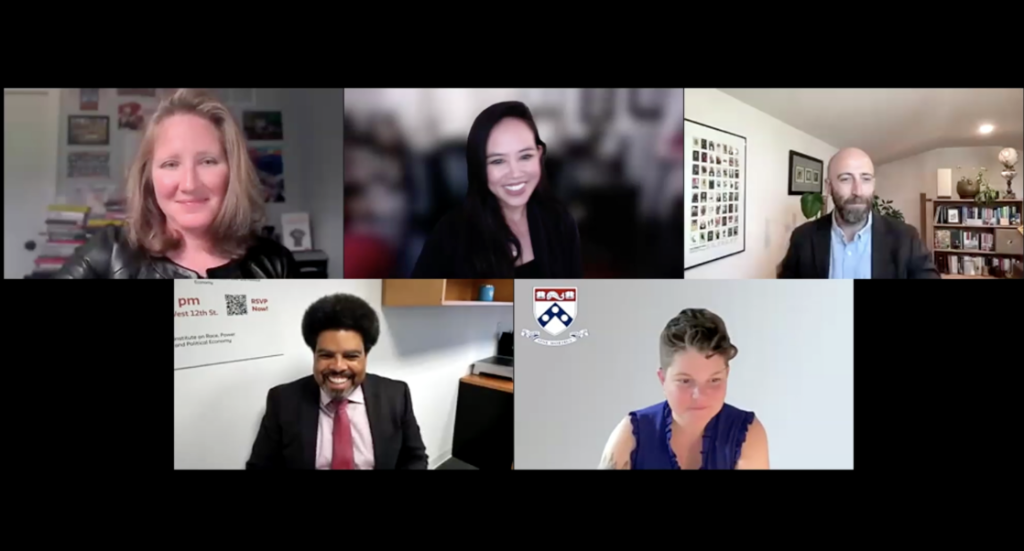
Thanks to everyone who joined The New School’s Public Banking Panel featuring Congresswoman Rashida Tlaib and CPBA’s Trinity Tran! Watch the recording and hear about how Public Banking and Guaranteed Income can work together to tackle income inequality, provide immediate relief, and build long-term structural change!
– Representative Rashida Tlaib, U.S. Representative, 12th Congressional District of Michigan
– Terri Friedline, Professor of Social Work, University of Michigan
– Darrick Hamilton, University Professor and Founding Director, Institute on Race, Power and Political Economy, The New School
– Amy Castro, Co-Founder and Faculty Director, Center for Guaranteed Income Research, and Associate Professor, University of Pennsylvania
– Trinity Tran, Executive Director, Co-Founder, and Lead Organizer, California Public Banking Alliance
– Graham Steele, Academic Fellow, Rock Center for Corporate Governance, Stanford Law School/Stanford Graduate School of Business, and Fellow, Financial Regulation, Roosevelt Institute
As federal support for climate and infrastructure shrinks, cities are turning to bold tools to build local economic power. Public banking is one of them.
Join us for a virtual roundtable, featuring our very own Trinity Tran, on how public banks can support guaranteed income programs and help build more inclusive, community-rooted economies. The event will spotlight new research from the Institute on Race, Power and Political Economy at The New School and feature leaders in public banking, economic justice, and guaranteed income. Featuring:
Terri Friedline, Professor of Social Work, University of Michigan
Darrick Hamilton, University Professor and Founding Director, Institute on Race, Power and Political Economy, The New School
Amy Castro, Co-Founder and Faculty Director, Center for Guaranteed Income Research, and Associate Professor, University of Pennsylvania
Trinity Tran, Co-Founder and Lead Organizer, California Public Banking Alliance
Graham Steele, Academic Fellow, Rock Center for Corporate Governance, Stanford Law School/Stanford Graduate School of Business, and Fellow, Financial Regulation, Roosevelt Institute
Hosted by: The Institute on Race, Power and Political Economy, The New School.
Read and download two new reports on how public banking can support economic equity and strengthen financial infrastructure for guaranteed income programs.
At a national convening in Washington, D.C., marking the launch of Demos and New Economy Project’s report, Public Banks for Racial Equity: Democratizing Finance to Build Community Wealth,CPBA’s Executive Director Trinity Tran and Legislative Director Sylvia Chi presented Dispatches From the Field: Wins, Lessons, What’s Next for California, a look at the statewide public banking movement’s milestones and future trajectory.
The report covers the California Public Banking Alliance’s leadership in passing the California Public Banking Act (AB 857), the first legislation in the nation to create a pathway for municipal public banks. CPBA’s work is cited as a model for how public financial institutions can “move public dollars out of extractive banking institutions and into investments that benefit working-class communities of color.”
CPBA is proud to be featured alongside organizers and public banking advocates from across the country committed to reimagining finance for racial and economic justice. As Trinity Tran notes in the report, “A public bank must be rooted in public interest and accountability to the communities it serves. We’re building the financial architecture to fund affordable housing, small businesses, and green infrastructure in communities that Wall Street has long ignored.”
The report features insights from CPBA along with Public Bank LA’s Legislative Director David Jette, showing how California is laying the groundwork for a network of socially and environmentally responsible public banks, designed to build economic power in low-income communities of color.
The California Public Banking Alliance’s Executive Director Trinity Tran led the passage of the first law in the U.S. to let cities and regions form public banks, backed by our California alliance of activists. We did this not by playing by Wall Street’s rules but by organizing across the state to build people power. Trinity then helped lead lead the passing of a second public banking bill now on its way to becoming to first universal banking services program in the U.S. Now we’re building the next phase: public banks that move billions into affordable housing, climate infrastructure, and community resilience.
CPBA’s Rick Girling writes in his latest op-ed: public banking advocates stand with the CFPB and against efforts to gut the few safeguards working people have left. Wall Street and billionaire tech moguls are coming for financial protections, but we’re not backing down. Read Rick’s piece in Stansbury Forum:
“Since 2012, consumers have been credited or saved more than $23 billion due to CFPB actions. The CFPB won a suit against Wells Fargo for $3.7 billion for decades of mismanagement of auto loans, mortgages, and deposit accounts harming more than 16 million Americans gaining them justice after suffering fraud. The CFPB recovered $363 million from lenders who scammed service members and veterans by violating the Military Lending Act. The CFPB instituted a rule limiting overdraft fees to $5 instead of the customary $20-35 that banks charge customers who have the least in their accounts, a projected savings of $5 billion to consumers. Unfortunately, Congressional Republicans killed this rule in April allowing banks to go back to charging whatever they want.
Organizations working to democratize finance such as the California Public Banking Alliance, the San Francisco Public Bank Coalition and Americans for Financial Reform strongly support the work of the CFPB. They are also strongly opposed to billionaire tech moguls and bankers’ attempts to defang these effective regulators and consumer advocates.” – Rick Girling, The Stansbury Forum
Our work is featured by world renowned progressive economist Gerald Epstein in his book Busting the Bankers Club: Finance for the Rest of Us! California has been a hub for the public banking movement, inspiring efforts nationwide. From the foreclosure crisis to the fight against Wall Street’s role in the Dakota Access Pipeline, our roots run deep in people power.
With the passage of our California Public Banking Act bill (AB 857), California became the first state to authorize municipal public banks, turning the vision of keeping public dollars local into law. AB 1177 followed, paving the way for CalAccount and universal fee-free banking access.
The book captures our work:
On Page 259, Epstein’s book captures our fight: “California has been a center of the public banking effort in the United States, and its recent successes have inspired public banking activists in other states. These efforts evolved first from the foreclosure crisis following the Great Financial Crisis in 2007-2009, and then received new energy from the grassroots movement advocating for divestment against the Wall Street banks supporting the Dakota Access Pipeline Project. The idea of divestment brought up an important question: where could local governments keep their funds instead? The lack of alternatives to Wall Street banks gave rise to the Public Bank LA initiative, which began a campaign to establish a municipal bank that would be owned by the city of Los Angeles and would manage city funds in the public interest.”
Page 260 “…this momentum was translated into the formation of the California Public Banking Alliance, a coalition of ten public banking grassroots groups across the state. In 2019, this coalition won a great victory: the state of California passed the first municipal banking legislation in the country, AB 857, authorizing the state to charter ten municipal banks over seven years. This victory set in motion actions by public banking organizations in multiple California municipalities and several regions to attempt to establish municipal and regional public banks…
“This legislation was followed by a second victory, the passage of the Public Banking Option Act (AB 1177), which, according to the California Public Banking Alliance, is ‘landmark legislation guaranteeing universal free banking access to all Californians’. AB 1177 sets into motion the creation of the CalAccount program guaranteeing all California residents access to basic banking services without fees or penalties. The California Public Banking Option Act addresses the inequities in financial services acutely felt by communities that have been hardest hit by the pandemic and recession, inequalities such as discrimination, predatory lending, and vicious spirals of debt.
“The passage of these two pieces of legislation has inspired public bank groups in other states. An important lesson from California is that a broad coalition with intensive organization and persistent activity is necessary to pass and implement such legislation over the opposition of the Banker’ Club going up against the inertia of the ideological prejudices and risk aversion characteristics of many key officers in legislatures and state and local bureaucracies.”
San Diego County Board of Supervisors acting Chair Terra Lawson-Remer called for bold local action in Wednesday evening’s State of the County Address, including the creation of a public bank to finance affordable housing. She stated the need for the County to step up when the federal government falls short in serving residents: “We can wait, or we can lead.”
Additional press in CBS! San Diego County Board of Supervisors acting Chair Terra Lawson-Remer called on it to take a stronger role in providing for residents, including possibly establishing a public bank to pay for affordable housing, in Wednesday evening’s State of the County Address.
At the Catalyst Convening in Long Beach on March 26, 2025, hosted by the Governor’s Office of Land Use and Climate Innovation (LCI) and the California Strategic Growth Council (SGC), CPBA’s Trinity Tran participated in a funding panel to discuss the California Public Banking Act. Trinity discussed how public banks keep money local, funding climate action and affordable housing, and how a state public bank can address California’s urgent funding needs amid shifting federal priorities.
On the panel were:
Trinity Tran Cofounder and Lead Organizer California Public Banking Alliance
Amar Azucena Cid Deputy Director, Community Investments and Planning California Strategic Growth Council
Geoffrey Ross Director of Government Services Horne LLP
Moderated by: Angie Hacker California Climate & Energy Collaborative CivicWell
The event convened local, regional, and tribal governments, community organizations, and state agencies to address climate, land use, and energy issues, co-create policies, and identify funding opportunities for local solutions.
Rashida Tlaib Highlights Our Public Banking Movement in The Guardian!
Congresswoman Rashida Tlaib and Michael McCarthy give a shout-out to our grassroots public banking movement in The Guardian!
“From Los Angeles to New York, for example, there are dozens of grassroots movements across our country building public options for finance. Democratic public banks and public asset managers are not run by a corporate board at the command of profit-driven shareholders lounging on yachts somewhere on the other side of the world. Powered by democratic mandates, they can make investments in renewable energy, affordable housing, community wealth-building, and other institutions that meet people’s real needs.”
Catalyst Convening: Local Solutions & Public Banking
At the Catalyst Convening in Long Beach on March 26, 2025, hosted by the Governor’s Office of Land Use and Climate Innovation (LCI) and the California Strategic Growth Council (SGC), CPBA’s Trinity Tran participated in a funding panel to discuss the California Public Banking Act. Trinity discussed how public banks keep money local, funding climate action and affordable housing, and how a state public bank can address California’s urgent funding needs amid shifting federal priorities.
The event convened local, regional, and tribal governments, community organizations, and state agencies to address climate, land use, and energy issues, co-create policies, and identify funding opportunities for local solutions.
The People’s Lobby! Public Banking for California’s Future
It was a packed day, including productive meetings with Senator Monique Limón (D–Santa Barbara) and Assemblymember Mark Gonzalez (D–Los Angeles) as well as meeting with staff from a number of other legislators.
As cities grapple with budget deficits and federal threats to local resources, the time is ripe for public banking to come into being, leveraging public funds to invest in our communities and generate revenue to strengthen community sustainability. It’s time to mobilize public money for the public good.
With nearly 8 million Californians unbanked or underbanked and federal consumer protections under threat, we need the state to lead on CalAccount, ensuring that basic banking is treated as a right. Considering that many businesses nowadays won’t even take cash payments, a free debit card is a necessity. Stay tuned for the final phase of the CalAccount campaign kickoff!
CPBA Members with Senator Monique Limon and Assemblymember and Majority Whip Mark Gonzalez.
Calling All Banking and Finance Experts!
We’re seeking experts in banking and finance to join our Technical Working Group. We’re addressing challenges related to statewide public banking efforts, including regulatory requirements, alternative structures, capitalization, and more. We’re also exploring the reintroduction of our California State Bank bill.
We’re sharing a helpful resource from our allies at The Democracy Collaborative: TRACKING THE CRISIS – a weekly news round-up covering administrative, legislative, and other actions by the new U.S. Administration, along with responses from legal, social, political, and economic movements.
This round-up serves as a tool to navigate the rapidly shifting political and economic landscape of the United States.