Category: California Public Banking Alliance

Public banking would help speed the economic recovery from COVID-19

April 17, 2020 – The Hill. Rick Girling of the California Public Banking Alliance and Isaiah Poole with Next System Project lays out the case for why public banks are a necessary engine for economic recovery.

At least 90 percent of the nation’s cities are facing a budget crisis because of the economic shutdown in response to the COVID-19 pandemic, according to a mid-April report by the U.S. Conference of Mayors and the National League of Cities. Because municipal governments cannot run deficits, they will have to respond by cutting staff and programs, which will worsen the economic conditions of the cities they serve.

If cities had public banks, they would be much better equipped to deal with these budget shortfalls and maintain the services and staff most vital to their economic recovery. That’s why state and local political leaders should use emergency powers to rapidly create public banks that can serve as key engines of a just and sustainable economic recovery.

Public banks are new to most of us in America, but they have been a proven institution globally for the past few hundred years. The one place in America where public banking is not new is North Dakota, where the 100-year-old Bank of North Dakota is widely credited with helping the state’s economy weather the 2008 recession far better than other states. 

In 2019, the California Public Banking Alliance ushered through the California legislature historic legislation, AB 857, The Public Banking Act. This law for the first time allows municipalities across the state to set up public banks in their communities. An increasing number of states and localities are considering following California’s lead.

A public bank, capitalized with the deposits that cities now park in Wall Street banks, will be a ready source of funds to help people and businesses sustain themselves through these hard times and rebuild. Public banks, like all banks, are able to multiply the impact of their capital by leveraging it up to ten times in loans. They provide the most efficient means for expeditiously deploying funds quickly to help recovery efforts, such as the low-interest loans to small- and medium-sized businesses to help them get back on their feet. 

Public banking would help speed the economic recovery from COVID-19

ÂĐ Getty Images

At least 90 percent of the nation’s cities are facing a budget crisis because of the economic shutdown in response to the COVID-19 pandemic, according to a mid-April report by the U.S. Conference of Mayors and the National League of Cities. Because municipal governments cannot run deficits, they will have to respond by cutting staff and programs, which will worsen the economic conditions of the cities they serve.

If cities had public banks, they would be much better equipped to deal with these budget shortfalls and maintain the services and staff most vital to their economic recovery. That’s why state and local political leaders should use emergency powers to rapidly create public banks that can serve as key engines of a just and sustainable economic recovery.

Public banks are new to most of us in America, but they have been a proven institution globally for the past few hundred years. The one place in America where public banking is not new is North Dakota, where the 100-year-old Bank of North Dakota is widely credited with helping the state’s economy weather the 2008 recession far better than other states. 

In 2019, the California Public Banking Alliance ushered through the California legislature historic legislation, AB 857, The Public Banking Act. This law for the first time allows municipalities across the state to set up public banks in their communities. An increasing number of states and localities are considering following California’s lead.

A public bank, capitalized with the deposits that cities now park in Wall Street banks, will be a ready source of funds to help people and businesses sustain themselves through these hard times and rebuild. Public banks, like all banks, are able to multiply the impact of their capital by leveraging it up to ten times in loans. They provide the most efficient means for expeditiously deploying funds quickly to help recovery efforts, such as the low-interest loans to small- and medium-sized businesses to help them get back on their feet. 

Imagine the difference it will make when a network of public banks exists to partner with the Small Business Administration to help execute the Paycheck Protection Program authorized by Congress. Instead of small businesses being frustrated trying to work with the commercial banks to obtain the loans, and having no place to turn when the agency announced the program ran out of funds on April 16, public banks would be there to stand in the gap. 

Continue reading on The Hill.

Read More
voicesofcalifornia

Voices of the California Progressive Alliance

SF Bay View – January 17, 2020. About 500 people gathered in the Pauley Ballroom on the University of California-Berkeley’s campus for the second annual meeting of the California Progressive Alliance (CPA) on Jan. 12. Trinity Tran of the California Public Banking Alliance spoke to Diana Cabcabin:

“Public banking is an idea that we introduced into the California State Legislature in 2019. It took a considerable amount of work to build political capital behind this bill and move the public banking conversation into the political mainstream. We are not the first organization to pass a state public banking bill [AB 857], but what we accomplished was extraordinary.

“This was a high profile and controversial bill facing heavy opposition from nine big financial firms but, without any corporate funding, we coordinated strategy with activists and supporters from across the state and got it passed. We built an endorsement list of 200 statewide regional and community organizations, including national organizations like Our Revolution and national figures like Sen. Bernie Sanders, who backs this bill.”

Continue reading on SF Bay View.

Read More
bestsolutions

Next City: 19 Best Solutions of 2019

The editorial staff gathered 19 of the year’s best ideas into their Solutions of the Year print magazine. Rounding out the top 19 solutions is the California Public Banking Alliance’s AB 857 Public Banking Act!

Oscar Perry Abello reports on California’s adoption of Assembly Bill 857, which creates a legal pathway for public banks owned by city and county governments. Proponents envision a network of public banks that will leverage local public deposits in support of policy priorities such as affordable housing, clean energy, small business lending and alternatives to payday loans. “Part of why our message resonated with so many â€Ķ was because everyone understands intuitively that Wall Street is extractive, is predatory,” says Trinity Tran, the California Public Banking Alliance’s lead organizer on the bill. “Why are we using our tax dollars to harm communities when we could use it to help our communities?” 

This 80-page special issue highlights the programs, people, and projects that are making cities more equitable and sustainable. Continue reading at Next City.

Read More
trinity tran

Trinity Tran and Sushil Jacob on How Community Organizing Can Advance Public Bank Legislation

NextCity, December 3, 2019: Watch guest presenters, Trinity Tran and Sushil Jacob of the California Public Banking Alliance, discuss how they organized citizens to help pass public banking legislation in California. This webinar is the second installment of our 2019 Solutions of the Year webinar series.

Continue on NextCity.

Read More
thepeople

THE PEOPLE V WALL STREET: CALIFORNIA’S PUBLIC BANKING SHAKE-UP

November 5, 2019. Glenn Daigon with Who.What.Why talks with Assemblymember David Chiu and the Alliance’s Trinity Tran. From successful legislating to overcoming the clout of big finance, California’s new public banking law is reverberating across the country.

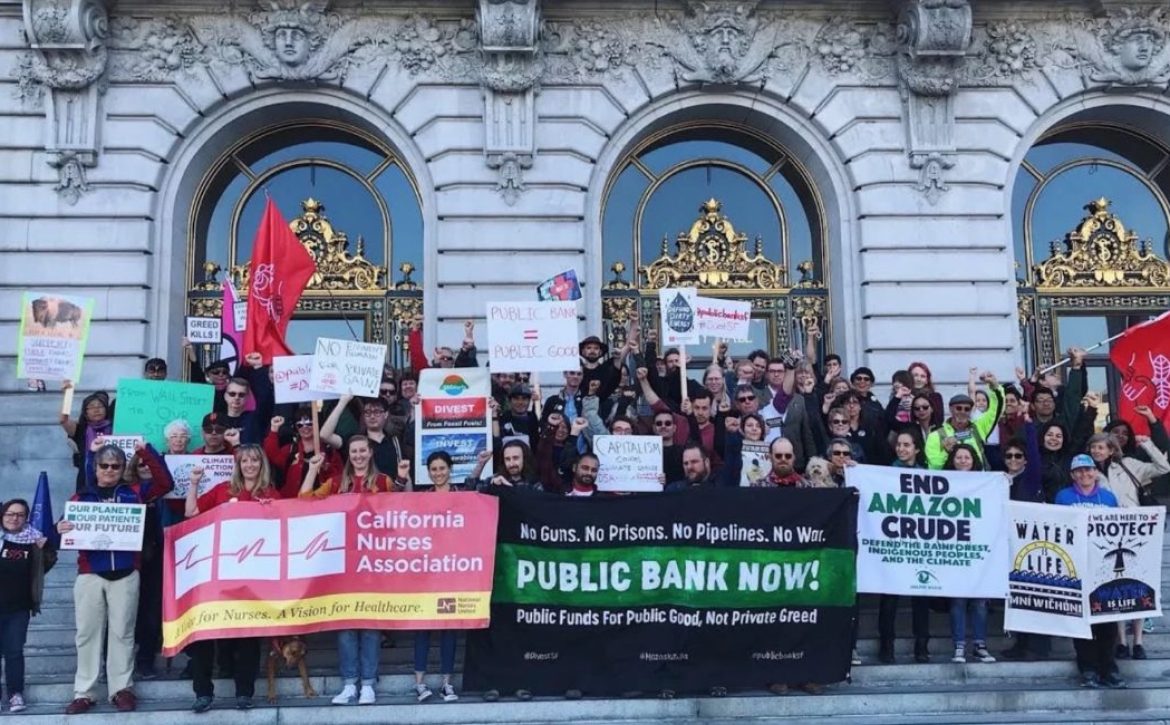
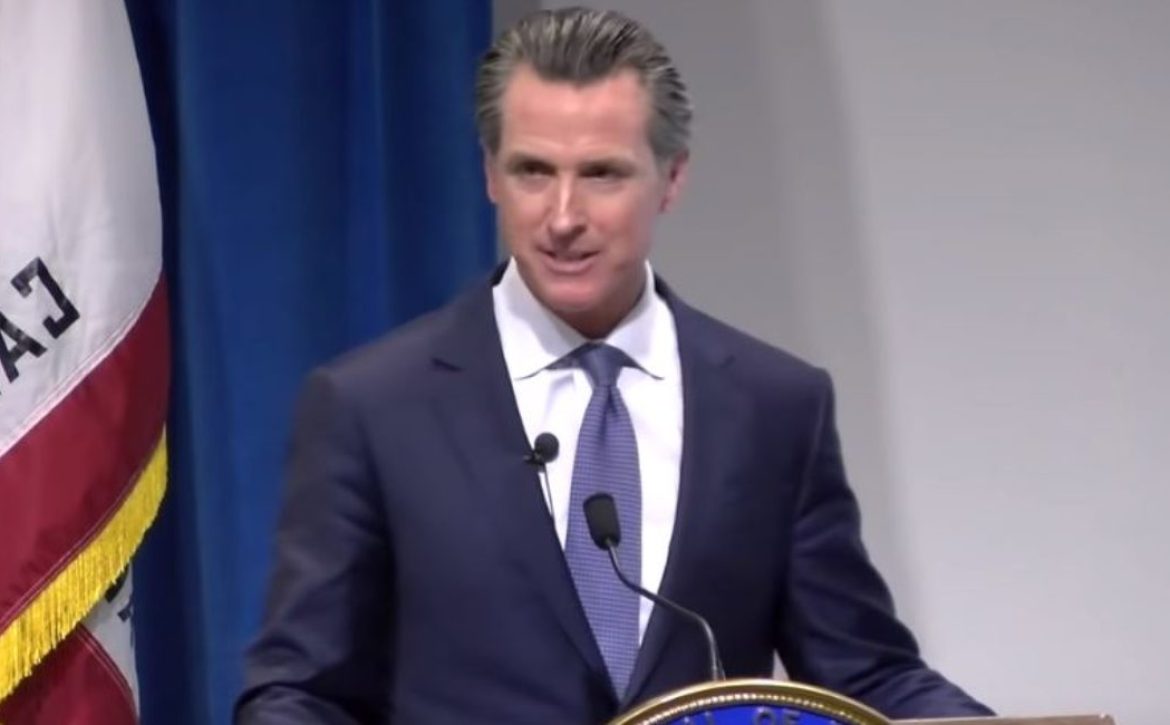
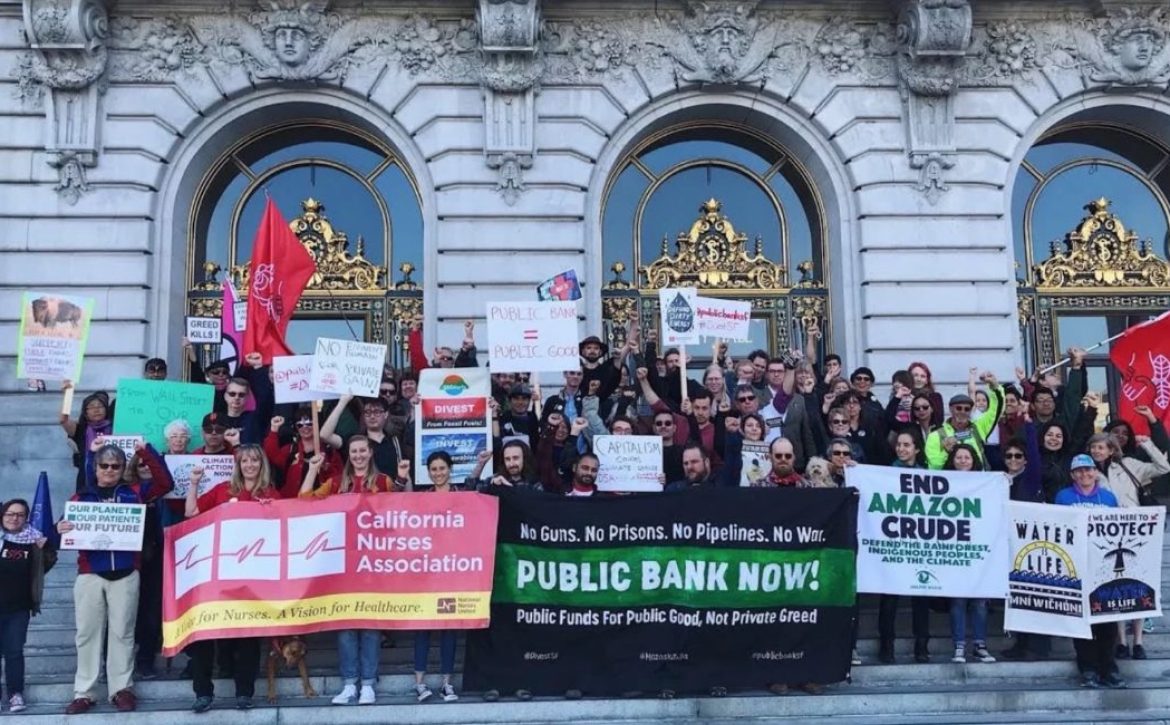
For only the second time in 100 years, a people-powered coalition overcame the stiff opposition of the banking lobby to successfully pass a law that legalizes public banking. Governor Gavin Newsom (D-CA) signed a bill into law last month allowing California cities and towns to establish public banks.

Continue reading on Who.What.Why.

Read More
financecanbesometing

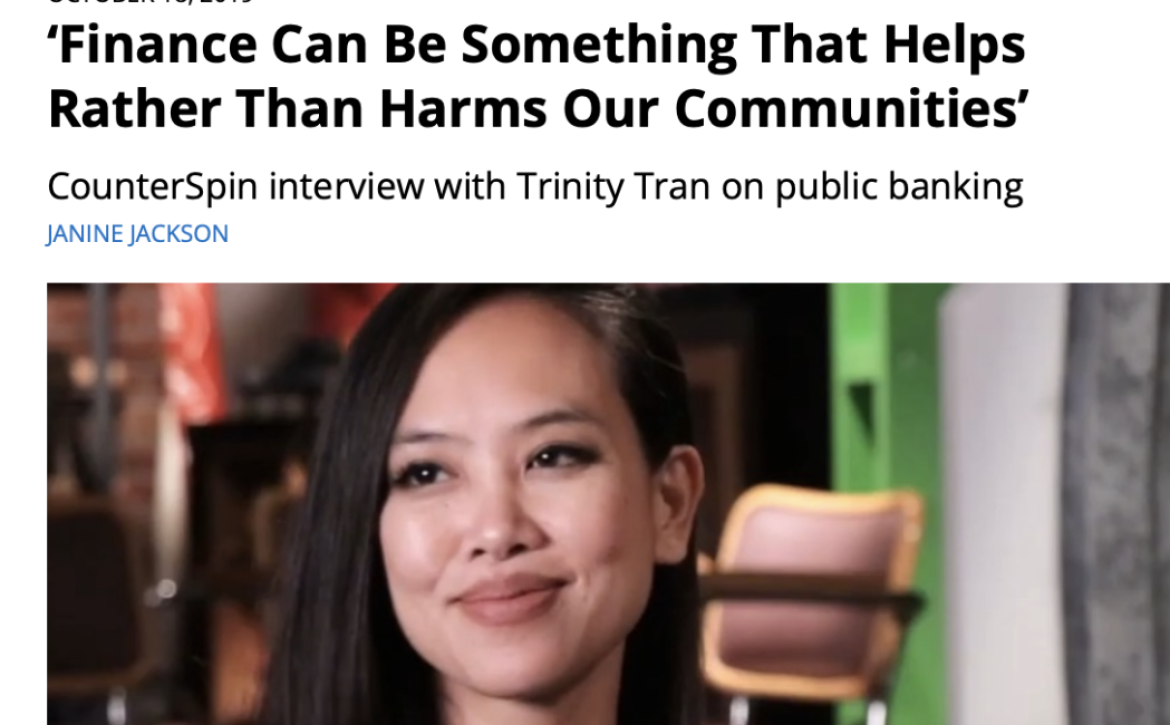
Finance Can Be Something That Helps Rather Than Harms Our Communities

FAIR’s Janine Jackson interviews Trinity Tran on AB 857.

The October 2 Fresno Bee reported that California Gov. Gavin Newsom signed a law allowing cities in California to start their own public banks, to make it easier to fund projects in the public interest. Atypically for such a story, the Bee led with opponents’ argument that “such ventures are risky and impractical,” before offering supporters’ successful view, and a statement from the bill’s author, which the story then undercut with the reporter’s claim that “analyses” determined public banks “could reduce state tax revenue.” Followed by a statement from the California Bankers Association that public banks could “harm local banks,” put taxpayer dollars at risk, and “aren’t always in the best interest of the public.” Before closing with the words of the head of the Howard Jarvis Taxpayers Association that the commercial banking industry already provides any services public banks could, and “government tends to mess up most of the things it touches.”

While that story was almost humorously negative, don’t expect a lot of corporate media love for public banks, precisely to the extent that they represent, as David Dayen wrote recently, “a radical shift in understanding money, what it represents, and how it can work collectively.” Of course, that’s exactly why the idea, and this historic step, is so exciting. Joining us now to talk about what just happened in California is Trinity Tran. She’s the co-founder and lead organizer for Public Bank LA, and a founding member of the California Public Banking Alliance. She joins us by phone from Los Angeles. Welcome to CounterSpin, Trinity Tran.

Continue reading on FAIR.

Read More
pressroundup

PRESS ROUNDUP! Public banks are officially law in California! Read our latest press on AB 857.

Read More

California’s More Than Dreamin’ about Public Banks

Oscar Perry Abello of NextCity talks with Sushil Jacob and Trinity Tran with the California Public Banking Alliance, Long Beach Mayor Robert Garcia and Kat Taylor with Beneficial Bank on AB 857, the historic bill that will “set in motion massive structural economic change” in California and could change the future of finance!

A bill to set in motion massive structural economic change could easily be hundreds, maybe thousands of pages long. AB 857 — which creates a legal pathway in California for public banks owned by city and county governments, where cities and counties would deposit public dollars — clocks in at a mere 29 pages.

“What we wanted to do was create a very lightweight bill that grafts public banks onto the existing state banking law rather than create a standalone financial code section that only covers public banks,” says Sushil Jacob, who played a lead role in drafting the bill as the legislative committee co-chair for the California Public Banking Alliance, a coalition of grassroots groups hailing from ten cities across the state.

Keeping the bill relatively short and sweet was essential, Jacob says, to crafting something that legislators and legislative staff and lawyers and consultants could digest, deliberate over, and ultimately pass in the same year it was introduced.

Of course it was also crucial that, since the bill’s introduction in February, the alliance rallied support for AB 857 from over 180 organizations across the state, including 17 city and county governments. The governor has until October 13 to sign it into law.

Continue reading on NextCity.

Read More
publicbanksnow

Public Banks Now

CPBA organizer David Jette writes about our journey, the future of the movement and the transition to a equitable and sustainable economy on the path paved by public banks.

The California Senate has voted to enact AB 857, the Public Banking Act, which sets the standards and opens the door for municipal public banks throughout the state.

A second vote on the amended bill in the Assembly, which advanced it by a narrow margin last month, should follow tomorrow. If Governor Gavin Newsom signs the bill into law, California will be the first state since North Dakota in 1919 to enact a statewide public banking statute, and the first in history to define and regulate the formation of public banks under an ongoing licensing regime. And while these banks are likely to start small in cost, number, and competitive scale, these first steps toward a new horizon will hasten the dawn of a new American economy, one that is accountable to the wellbeing of the people and the planet.

Lobbyists from the California Bankers Association and their affiliated industry groups tried their best to kill this bill, and they succeeded in pressuring moderates in the legislature to water it down, by limiting the ways public banks can compete with private banks. But in the end, they failed to overcome the urgent desire of Californians to divest from banks which finance extractive and exploitative businesses, defraud their customers, and take risks that lead to trillion dollar, taxpayer funded bailouts and global economic collapse. Lawmakers recognized the need to declare independence from Wall Street and establish publicly-owned, public-purpose banks with more transparency, more accountability, and with an unshakeable commitment to local, equitable, sustainable and restorative investment.

As a hired security force hired by Dakota Access LLC descended on the protest at Standing Rock, they coordinated with state and federal authorities to provide “counterterrorism measures” to protect the pipeline project from the threat of peacefully gathered Lakota water protectors and their allies, who were camping in freezing temperatures and whose rights to tribal autonomy and free speech were being presently litigated at the UN. Folks traveled from all over the country to stand with Standing Rock, and when the state and fossil fuel industry united to snuff out that resistance, those folks went back to cities all over America with a bone to pick with the financiers and enablers of that attack.

Wells Fargo was a co-financier on the project, although as the bank itself points out, it contributed just 4.8% of the project’s credit facility, while 17 other banks provided forms of financing. That Wells Fargo was also the subject of investigation for illegally cross-selling products to customers without their consent (for which it has paid hundreds of millions in settlements to customers and shareholders) widened the target. And the bank’s involvement in the illegal foreclosure of homes following the financial crisis made them a target for housing justice activists all over the country.

Continue reading on Sydiot.

Read More
approve

Could California Approve Public Banking?

Sonali Kolhatkar​ on Rising Up With Sonali talks with Trinity Tran with the California Public Banking Alliance on the Los Angeles Measure B initiative and the #AB857 campaign barreling its way through the California State Legislature.

A local measure in Los Angeles, California, last year to establish a public banking system failed. But organizers did not give up and instead set their sights even higher. A bill, AB 857, introduced by Assemblyman David Chiu to allow municipalities in California to establish their own public banking system has now gained steam and is working its way through various committees. Based on the idea that public money should be held in public institutions rather than private Wall Street banks, organizers are more hopeful than ever for a public banking system to become a reality.

Watch on Rising Up With Sonali.

Read More