SF Gate – March 15, 2022. A vision for a public bank in the East Bay– and possibly only the second one in the country– got a boost Tuesday when Alameda County Supervisors voted to give $75,000 to a group aiming to start one.
Supervisors voted unanimously to give the money to Friends of the Public Bank East Bay, which has already taken steps to start a bank. (Supervisor Richard Valle was excused from the meeting.)
The money from the supervisors is for planning activities, according to a letter to the board from Supervisor Dave Brown. The money is coming from Brown’s fiscal management reward funds.
“A public bank would provide many public benefits to the community,” Brown wrote. “It would create a long-term multigenerational source of capital for East Bay communities, and would cut infrastructure construction costs significantly by providing low-interest loans.”
Brown added that such a bank “would return profit and interest to local communities and bring transparency and democracy to banking and investment of public funds. Lastly, a public bank would help strengthen local banks and credit unions by backing their loans and letters of credit.”
Friends of the Public Bank East Bay have already completed a viability study for a public bank, according to the group’s website. A viability study is a necessary step under the California Public Banking Act.
The California Public Banking Act was established by Assembly Bill 857 and signed by Gov. Gavin Newsom in 2019. The law enables government entities to form public banks.
Friends of the Public Bank East Bay are now working on a business plan, another step in the process required by law.
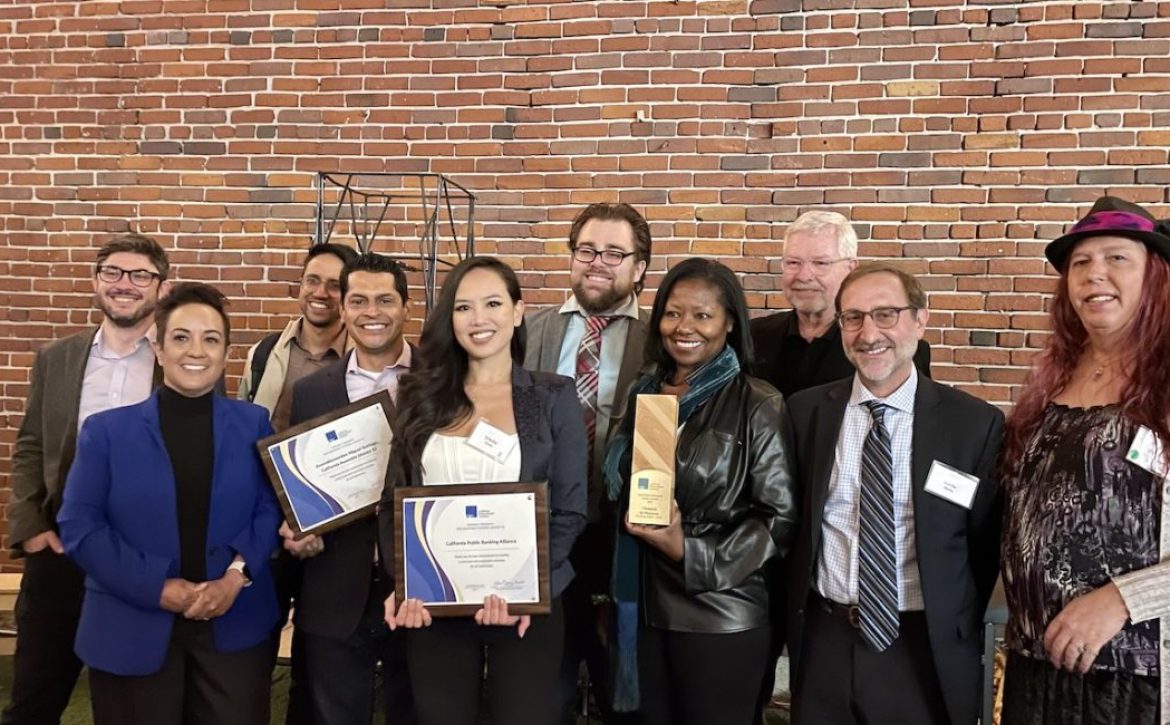
Public Banking took a huge leap forward this year with many first-in-the-nation accomplishments.
• Passage of first-in-the-nation bill for universal free banking services. The California Public Banking Alliance (CPBA) and our allies pushed the California Legislature to enact Assembly Bill 1177 in order to provide financial services for unbanked or underbanked Californians. On October 4, 2021, Governor Gavin Newsom followed up by signing the California Public Banking Option Act (AB 1177) into law.AB 1177, authored by Assemblymember Miguel Santiago, authorizes a commission of financial access experts, community members, and government representatives to begin implementing the CalAccount program. Upon securing final approval from the Legislature, the program will create a state-sponsored retail banking option offering a zero-fee, zero-penalty debit card enabling direct deposit from employers and public benefits, automatic bill pay, and many other financial services to every Californian.
California Public Banking Alliance joined with SEIU CA, California Reinvestment Coalition, public banking advocates, unions, and community organizations across California to pass this landmark legislation that will help close the racial wealth gap fueled by the exclusion of low-wage communities of color from basic banking services.
• The California Public Banking Option Blue Ribbon Commission is getting underway. The Governor, Treasurer, and Senate and Assembly Leadership are now in the process of selecting and seating the CA Public Banking Option Blue Ribbon Commission to begin operations in 2022, as required by AB 1177. CPBA is working to make sure it fulfills its promises.
In the months ahead, the CalAccount Blue Ribbon Commission will convene to conduct a market analysis and to determine the best way to implement the CalAccount program. There will be opportunities for advocates to take part in shaping the CalAccount program and co-hosting public outreach forums.
• CPBA local affiliates are establishing the nation’s first municipal banks. Local public banking advocates are busy in San Francisco, Los Angeles, the East Bay, the Central Coast, Pomona Valley, San Diego, North Coast, and Humboldt County, working with their representatives getting their local public banks up and running. This is no small task. There is much work to be done to fulfil the requirements of AB 857, the California Public Banking Act passed in 2019.
• City and county representatives need to pass enabling legislation.
• Publicly-minded banking experts need to be located and summoned to fulfil the requirements of AB 857.
• Money needs to be allocated.
• Business plans need to be drafted.
• Banking managers and administrators need to be identified Read our status updates on California Public Banking Alliance cities and regions.
• On the Federal level and across the nation, public banking is sprinting ahead. On the Federal level and across the nation, public banking is sprinting ahead. The House Committee on Financial Services, chaired by California’s Maxine Waters, held one of its first hearings on public banking. During the hearing on “Banking the Unbanked: Exploring Private and Public Efforts to Expand Access to the Financial System,” Reps. Rashida Tlaib and Alexandria Ocasio-Cortez discussed the Public Banking Act of 2021 to foster the creation of public banks across the country by providing a pathway to establishing an infrastructure for liquidity and credit facilities via the Federal Reserve, and setting up federal guidelines for regulation.
Additionally, public banking advocates in New York, New Jersey, Massachusetts, Philadelphia, and many other states and cities throughout the US are pursuing establishing public banks.
The many accomplishments of 2021 will build momentum for the coming year and lay the foundation for our next steps in 2022 and beyond: Getting control of our money out of the hands of Wall Street banks, providing financial services to those most in need, and getting our municipal public banks up and running so our cities and counties can provide permanently-affordable housing, support small and worker-owned businesses, enable community solar, and meet other critical needs.
ABC7 News – October 8, 2021. Los Angeles might be the first major metropolitan city to create a public bank. A public bank would be owned and operated by the city.
Los Angeles City Council voted unanimously to take the first steps in seeing the viability of a public bank. According to city councilmembers, it aims to help low-income communities and could provide investment opportunities at a local level. And they say the bank operations would include:
Credit access for small businesses Financing for affordable and social housing Plus, opportunities for green energy investments
Continue reading and watch the video on ABC 7 News.
The basic functions of investment are too important to be left in the hands of private banks only interested in accruing profits. We need public banks — something the Public Banking Act, introduced by Reps. Alexandria Ocasio-Cortez and Rashida Tlaib, would provide.
While only a few dozen people across the country might tune in to a Wednesday morning subcommittee hearing under the House Financial Services Committee on solutions to increase access to our nation’s banking system, millions have now seen the viral clip of Rep. Alexandria Ocasio-Cortez taking her colleagues to task for failing to read the legislation on which they were commenting. And if you’d read the bill before hearing their comments, it’d be clear as day.
The Public Banking Act, introduced in October 2020 by Representatives Ocasio-Cortez and Tlaib, mirrors legislation that has been introduced in several states and passed in California, establishing a federal regulatory framework to oversee and service publicly owned banks at the municipal and state levels that place communities’ needs over corporate greed. After all, if private banks have FDIC insurance, access to the Federal Reserve and Treasury, and are (insufficiently) regulated by governments, then why wouldn’t public banks?
What does it not do? Establish a national bank (the Federal Reserve is our central bank), take over private banks, create a single public bank, or funnel unlimited amounts of taxpayer revenue into high-risk loans, as Republicans on the committee claimed. Nevertheless, they insisted that a public-banking option would usher in an economic apocalypse and the death of American industry and innovation.
The hearings on public banking are the same every time. With every opportunity, Wall Street lobbyists and think-tank pundits — consistently the sole critics of public banking — pop up to repeat the same tired talking points: “Have you been to a DMV?” or “Big Brother is coming to crush competition and steal our freedoms and property!” These claims come despite legislation in numerous cities, states, and now Congress explicitly stating otherwise, and primarily serve to muddy the waters.
The CATO Institute and Competitive Enterprise Institute (both directly funded by the Charles Koch and fossil-fuel corporations, among others) and the American Bankers Association (the lobbying arm for Wall Street megabanks) have blatantly lied and misrepresented what public banking legislation clearly states to protect a status quo of private banks that have failed to invest in socioeconomic and environmental crises when they’re not deemed profitable. While Republicans in Congress didn’t bother to read the bills, they had no problem memorizing the talking points fed to them by the bankers and their think tanks.
What is public banking and why is it so scary? All one has to do is look to the Bank of North Dakota (BND), a bank owned and operated by the State of North Dakota. BND partners with credit unions and community banks across the state to increase lending capacity to the residents of North Dakota at more affordable rates, rather than letting Wall Street giants price gouge North Dakotans to maximize profits.
The result? North Dakota has more credit unions and community banks per capita than anywhere else in the country, and BND routinely returns its surpluses into the state’s general fund to increase funding for public projects. Most impressively, through its requirements to make safe and sound investments, it was one of only a few banks in the country to operate in the black throughout the 2008 financial crisis and the 2020 recession sparked by COVID. Additionally, it has been a shining example and processed more PPP loans to North Dakotans than any financial institution in the country.
Over the past several years, we’ve seen what looks like an apocalypse as wildfires left California’s skies bloodred and choked by smoke, entire towns reduced to rubble, nearly all of which were found to be directly due to mismanaged infrastructure by the state’s largest energy corporations. For decades, hurricanes have been leaving cities across the South underwater and ravaged after hurricanes.
Every year sees more carnage across the world as the clock to complete climate catastrophe ticks toward zero. The only path forward to save humanity is to face these crises head-on and build a new economic foundation capable of overhauling our energy grid to 100 percent renewable, building sustainable and truly affordable housing and transit systems and much more. It’s vital that our governments are equipped with every tool possible to mobilize the resources needed.
Thanks to the work of grassroots organizers in cities up and down the state, 2019 saw the first public-banking legislation in a century pass in California, creating a regulatory framework and pathway for municipalities to establish public banks. Through the creation of public banks in California, cities like San Francisco, Los Angeles, New York, Philadelphia, Seattle, Chicago, San Diego, and many more would have additional tools to invest their public revenues and assets into large projects like public infrastructure, renewable energy, affordable housing, and partnering with local banks to further increase their lending capacity and spur more affordable investment in small business, housing, education, and more.
The for-profit megabanks have almost completely monopolized public finance and failed miserably to provide the services needed by the communities they’re chartered to serve. Due to a lack of public options, every city in the country is forced to turn to Wall Street titans for banking services, held hostage by the banks’ profit margins and predatory practices. Millions across the country lack access to most basic financial services such as a checking or savings account, which the for-profit banking industry has continuously failed to provide, forcing the most vulnerable residents across the country to turn to payday lenders and the check-cashing industries that charge up to 400 percent interest rates. And their investments have accelerated environmental destruction and wealth inequality by directly financing fossil fuels, weapons manufacturers, and private prisons.
Amid all of this, there is virtually no mechanism to hold such banks accountable for their crimes, let alone democratize our financial sector. It seems like common sense to many. We pay taxes to a government and expect them to use those funds to provide services to residents and improve quality of life. Yet the reality is that the taxes we pay are shipped off to Wall Street and used to underwrite loans to finance oil pipelines, defense contractors, and overpriced student loans.
These conditions call for immediate governmental intervention, ironically creating the competition that reactionary politicians cry for as a driver of progress and innovation, failing to realize that a robust network of public banks is the very competition that can set a new industry standard by charging lower interest rates on public infrastructure and providing capital to credit unions and community banks to more affordably meet the needs of local economies.
For-profit giants have branded themselves “too big to fail,” yet continuously fail to meet the most basic needs of the communities they’re tasked with investing in. It’s time to embrace the opportunity to build a better, more equitable alternative — one that’s accountable to the public and will uplift and empower the communities left behind by Wall Street. As Rep. Rashida Tlaib argues, it’s not that the banks are too big to fail, but that the people are too important to fail.
San Francisco has taken its first major step toward establishing a public bank, and other California municipalities are also moving forward in exploring public banking, including a regional effort by cities and counties on the Central Coast.
The moves come nearly two years after Gov. Gavin Newsom signed AB 857, enabling California cities and counties to form public banks. These are locally-controlled financial institutions into which municipal revenues — such as taxes and fees — are deposited. The money is then lent out to small businesses and infrastructure projects, among others, through partnerships with community banks. The goal is to directly benefit residents, while providing not-for-profit services for citizens who choose to use the bank.
A state public bank was formed in North Dakota more than a century ago, although no cities or counties in the nation have public banks. But the California statute reportedly is adding fuel to a nationwide public banking effort.
By law, a public bank in California must be run by banking professionals responsible to a board and overseen by California’s Department of Business Oversight.
“We finally have the option of reinvesting our public tax dollars in our local communities instead of rewarding Wall Street’s bad behavior,” Assemblyman David Chiu, a San Francisco Democrat and coauthor of AB 857, said at the time of the governor’s signing.
On June 15, San Francisco’s Board of Supervisors unanimously approved the San Francisco Reinvestment Working Group ordinance. Penned by Supervisor Dean Preston, the ordinance authorizes the creation of a working group made up of financial experts, community members, and representatives of the city’s Controller and Treasurer.
The working group has one year from its first meeting to create a business plan to present to the Board of Supervisors and Local Agency Formation Commission, which, if approved, will be submitted to the California Department of Financial Protection and Innovation.
However, before the working group can convene, it must be funded. Currently, there is no money earmarked in the mayor’s proposed budget to support a reinvestment working group.
The creation of the working group is the latest in San Francisco’s decade-long drive to establish a public bank which includes dozens of hearings, meetings and studies, including last year’s Municipal Bank Feasibility Task Force Report. That study outlined three possible routes that San Francisco get into public banking, all of which, if approved, will take years to see to fruition.
Cities and counties on California’s Central Coast are in the starting stages of creating a regional public bank.
Led by Santa Cruz County, resolutions supporting a Central Coast Public Bank viability study have been passed in Monterey and Santa Barbara counties, as well as the cities of Santa Cruz, Capitola, Seaside, Scotts Valley, Del Rey Oaks, and Watsonville.
According to Santa Cruz County Supervisor Zach Friend, San Benito and San Luis Obispo counties have also been asked to back a viability study. Currently, neither county has signed on. The viability study is the first step municipalities must take to create a public bank.
In May, Los Angeles made progress in its quest for a public bank. In a unanimous vote, the city’s Economic Development and Jobs Committee approved the motion for the formation of the Municipal Bank of Los Angeles. The motion now goes before the full city council, though no date has been set for its hearing.
North Dakota, through the efforts of its farm community, established a public bank in 1919, an institution that has survived Great Depression, widespread bank and savings-and-loan failures, and the Great Recession. If San Francisco, Los Angeles, or the Central Coast are able to establish their own, it will be the first for an American city or county.
While public bank proponents point to the Bank of North Dakota (BND) as a success story, critics of public banking counter that both BND’s scale and when it was established render such comparisons moot. Other critics, such as the CATO Institute’s Mark Calabria, use public bank failures from the 1800s in states like Vermont and Indiana as proof that public banking is a disaster waiting to happen.
The public banking law “infers that banks are not serving their communities, an argument repeatedly made by public bank activists in a variety of forums,” wrote the California Bankers Association, a leading public banking opponent. “Commercial banks, particularly community banks, will be harmed by the taking of local agency deposits which would otherwise be used as a source of liquidity by these banks to make loans into their communities.”
But supporters of public banking aren’t buying it, saying the public banks would retain revenues for the community and save the costs associated with private banking, among other benefits.
Public banks have the potential to “save local governments money, increase investment in affordable housing, infrastructure and other essential items,” says Santa Cruz’s Zach Friend.
“At a minimum, it’s important to explore the viability and possibilities of the formation and then to see whether this model makes sense for our region,” he added, “any method that would help improve investments in these challenges and save money to our communities is worthy of serious exploration.”
CBS Bay Area – SAN FRANCISCO (BCN/CBS SF) — June 15, 2021 San Francisco’s Board of Supervisors on Tuesday unanimously approved an ordinance that moves the city closer to creating the first public bank in the U.S.
The Reinvest in SF ordinance, authored by Supervisor Dean Preston, creates a working group of community leaders and financial experts to come up with a business plan to submit to the California Department of Financial Protection and Innovation for approval.
In addition to a business plan, the group will also come up with a timeline for the city to apply for a public banking license.
“The pandemic has laid bare the deep disparities that exist along social, economic, and racial lines,” Preston said. “As we chart a path to economic recovery, we need to look beyond corporate banks that prey on our most vulnerable communities.”
According to Preston, a public bank would allow the city to reinvest millions of its revenues toward initiatives that support working San Franciscans, including economic recovery, affordable housing, green infrastructure and small business loans.
KCET- LOS ANGELES (CNS) – June 1, 2021 The Los Angeles City Council today voiced its support for creating a statewide public banking option for California residents in an attempt to reduce racial and income inequalities in financial services.
“There’s no question that there’s a need for a public bank. The simple fact is that the current banking system has never truly worked for working people and specifically for communities of color,” said Councilman Kevin de Leon, who introduced a resolution to support the California Public Banking Option Act currently pending in the state Assembly. The resolution was unanimously passed by City Council members.
“The public banking option will level the playing field so that everyone — no matter how much money they make, the color of their skin, or which zip code they live in — can fully participate in our economic recovery.”
The California Public Banking Option Act would create the BankCal program, which would be the first statewide program in the U.S. to offer residents access to a no-fee, no-penalty bank account, including a debit card, automatic bill pay, direct deposit capacity and an infrastructure for the account holder to build credit. The bill was co-authored and introduced by Assemblyman Miguel Santiago, D-Los Angeles.
According to the resolution, which was introduced by de Leon and Councilman Curren Price, a quarter of California residents are “unbanked” or “underbanked,” and rely heavily on payday lenders, prepaid cards and pawn shops, causing them to proportionally pay more for their financial services, lack savings accounts and opportunities to build credit and face an increased rate of loan rejection.
The problem disproportionately affects low-income people and communities of color, and nearly half of Black and Latino households in California are unbanked or underbanked, according to the resolution, which used information from a survey conducted by the Federal Deposit Insurance Corporation.
“Providing banking services to the unbanked and underbanked is too expensive for community banks, credit unions and (Community Development Financial Institutions) to do efficiently,” stated the resolution, which was seconded by Councilwoman Nithya Raman.
The California Public Banking Option Act “would close the financial services divide, bolster the economy and ensure an equitable recovery by creating a stable, accessible financial services platform with the BankCal program,” according to the resolution, which added that it would “reduce Californians’ risk of falling into catastrophic debt traps and bring us closer to bridging the racial wealth gap.”
The Assembly bill would create a nine-member Public Banking Option Act that would design and implement the BankCal program. The board would select existing financial institutions to partner with and manage and coordinate the vendors for the program.
Ben Gordon, an organizer with Public Bank L.A. and the California Public Bank Alliance, called into the City Council meeting Tuesday to urge council members to approve the resolution. “This bill is an important step forward to bridge the racial equity and wealth gap in our state,” he said.
The Santa Barbara County Board of Supervisors passed a resolution this month expressing interest in participating in a viability study that would determine the feasibility of establishing a public bank with the five Central Coast counties.
“At least studying this as a possibility is a responsible decision in light of the hedging of risk and diversification as a way to minimize risk and at least have the possibility or returns,” First District Supervisor Das Williams said at the May 4 meeting. “I think it would be a responsible decision to analyze that, to analyze the possible benefit for the taxpayer and for the county. And if there is no benefit, then you don’t move forward.”
California Assembly Bill 857 created a process for local agencies to create a public bank, which is defined as a corporation organized for the purpose of engaging in the commercial or industrial banking business that is owned wholly by a local agency, local agencies or a joint powers authority, according to a letter filed to the board.
Before forming the bank, the bill requires the local agency to conduct a study to assess its viability.
Santa Cruz County Supervisor Zach Friend sent a letter requesting statements of interest in participating in the study to the five Central Coast counties: Santa Cruz, Monterey, San Benito, San Luis Obispo and Santa Barbara.
The study must include a discussion of the purposes of the bank, including achieving cost savings, strengthening local economies, supporting community development, and addressing infrastructure and housing needs for localities.
A fiscal analysis of costs associated with starting the bank and financial projections for the first five years of the proposed bank also must be included in the study. The financial projections should include an estimate of the time period for when expected revenues meet or exceed the expected costs and an estimate of the total operating subsidy that the agency may be required to provide until the proposed bank generates sufficient revenue to cover its costs, according to the board letter.
The study also must include an analysis of how the proposed governance structure of the public bank separates from unlawful insider transactions and apparent conflicts of interest.
The majority of board members were interested in participating in the study and thought the proposed bank offers an opportunity to reinvest money locally, reduce taxes or provide a major new source of income.
“This offers an opportunity to reinvest money that we are already collecting in taxpayer revenue and invest it locally,” Third District Supervisor Joan Hartmann said. “My real interest in this is that it could reduce the cost of public infrastructure projects by 35 to 50%.”
Williams said that a huge position of advantage would be if cannabis was part of the study’s analysis because the bank’s lending opportunities are fewer.
“I would imagine that there is at least a possibility of a competitive advantage on a public bank that is really looking to financing, borrowing or investing via that industry simply because we would not be shackled by the same federal prohibitions that most lending institutions have,” he said.
SALINAS — Monterey County elected officials have OK’d exploring the concept of joining other Central Coast counties to develop a public banking system that would provide benefits for economic development, infrastructure needs and affordable housing.
The Board of Supervisors on Tuesday gave the nod to exploring how interested Monterey County would be in joining Santa Cruz, San Benito, San Luis Obispo and Santa Barbara counties in a regional public banking system called the Central Coast Public Bank.
Introduced by Supervisor Luis Alejo, the decision was exploratory only and no taxpayer dollars would be used. If enough interest is generated, the county would then debate joining partner counties in conducting a feasibility study that would cost between an estimated $100,000 to $500,000.
The Santa Cruz County Board of Supervisors is taking the lead on developing funding for a viability study.
Senator Mike McGuire, Chair of the Governance and Finance Committee and Senator Steven Bradford, Chair of Banking and Financial Institutions Committee at the State Public Bank hearing.
California State Senators Mike McGuire and Steven Bradford took a bold step toward establishing a state public bank on November 23, 2020 by chairing a joint hearing with the Governance and Finance, and Banking and Financial Institutions Committees. The Senators unleashed testimony from a wide range of financial professionals and community activists supporting legislation for a state public bank.
The State Public Bank’s coauthor, Assemblymember Miguel Santiago stated the urgency of financial transformation for COVID-19 recovery by emphasizing “the need to reimagine a financial system that puts the public good before profit.” His appeal for California’s financial sovereignty was reinforced by Assembly cohort, David Chiu, stating that a state public bank “…could keep the people’s financial power in our state to ensure that we are jump-starting our state’s economic recovery, to catalyze the development of local financial institutions in their communities, providing infrastructure, capital, and support.”
Assemblymember Miguel Santiago and Assemblymember David Chiu, joint authors of the State Public Bank bill.
Three issues stood out from a myriad of speakers.
Wall Street banks have failed our communities, particularly people of color.
Taxpayers’ money needs to be used efficiently to assist those most in need by providing capital to revitalize small businesses and rebuild communities devastated by COVID-19.
A state public bank will counter the corrupting influence of big banks by providing investment opportunities for those doing social good: to build affordable housing; to build sustainable infrastructure; to support small business survival; to put people back to work while rebuilding our communities, especially those that are ignored by big banks.
State Treasurer Fiona Ma and Senator Maria Elena Durazo speaking at the State Public Bank hearing.
Public banking proponents gained traction with a series of well-informed presentations from public servants, entrepreneurs, community financial institutions and community groups. California State Treasurer Fiona Ma made it clear that she supports a thorough, appropriate study for the feasibility of a public bank. Henry Levy, Alameda County Treasurer and Tax Collector, noted “a lot of the county treasurers are in support of the goals of a public bank.” Senator Maria Elena Durazo spoke of the critical need for an alternative to Wall Street to address community and small business needs that the current system has failed to support. Durazo emphasized that officials should find ways to move bold ideas forward rather than dismiss them, and acknowledged “The private sector takes advantage of our funds but doesn’t reciprocate the way that it should for our communities.”
Ameya Pawar from Open Society Foundations pointed out that the government gives banks “…the license to create money. That is what the public provides private sector banks.” Mr. Pawar offered a solution to Senator Durazo’s concern, saying “There is no reason why the public sector couldn’t also obtain a license to create money, to fill in the gaps that are created by private sector banks.”
Ameya Pawar with Open Society Foundation and Mark Herbert, Vice President of California Small Business Majority testifies in support of a California State Public Bank.
Noni Ramos from Enterprise Community Loan Fund explained how a state public bank would help Community Development Financial Institutions be more effective. “CDFIs work to bring capital to low income and underserved communities and financial resources from the public bank could be leveraged by CDFIs.” Mark Herbert, Vice President of California Small Business Majority concurred, saying public banks provide “… the opportunity to think about, how do we get more tools and more resources and more capital to the smallest businesses?” He concluded that “…fundamentally we need to think about not just this moment — and meeting the significant needs that small business owners and our state face — but how do we build a more equitable economy in the future?”
Scores of community activists made their voices heard in public comment. Trinity Tran from the California Public Banking Alliance made it clear that a public bank will enable public funds for rebuilding and recovery. Ms. Tran reminded legislators at the hearing that while campaigning Governor Newsom committed to breaking the hold of Wall Street banks by establishing a state public bank. Jennifer Tanner, speaking on behalf of Indivisible CA: StateStrong’s over 70 groups with 40,000 members, registered strong support for a state public bank. Ben Hauck of Public Bank Long Beach, called on legislators to take bold action for public banking as a systemic solution to a broken financial system.
Members of UFCW Western States Council.
United Food and Commercial Workers (UFCW) Local 770’s Political Director Nam Le spoke on behalf of 150,000 grocery and retail frontline workers. The union supports public banks capable of partnering with community banks and credit unions to lend responsibly to localities, especially communities of color, which have suffered the greatest losses in the pandemic. Steve Sittig of Public Bank Pomona Valley pointed out that a state public bank can smooth the way for setting up local and regional public banks.
Joining the overwhelming support for a state bank in the public comment section were California Reinvestment Coalition (CRC), a key ally in California Public Banking Alliance’s effort, representing over 300 California small businesses and CDFIs, and the People’s Alliance for Justice testifying on how a State Public Bank will be able to support CDFIs in their work with the unbanked, leveling the playing field for our most needy.
Richard Girling of United Educators of San Francisco and SF Public Bank Coalition urged legislators to look to Germany’s Sparkassen, a network of hundreds of public banks that have operated for a couple hundred years. Rose Anwich from Ventura County expressed her concern that Wall Street banks continue to finance extractive industries and that public banks are needed for financing climate resilient initiatives. Bonnie Petty, from North Bay Jobs with Justice, noted that had there been a state public bank, recovery funds could have been leveraged to provide much more relief from the fires that destroyed communities.
In a recent newsletter by the Public Banking Act’s co-author Asm. Phil Ting, the Legislative Analyst estimated “a one-time $26 billion windfall in revenues this coming year. However, deficits are projected for several years thereafter. In addition, COVID-19 cases are surging, potentially exacerbating our economic challenges and the number of vulnerable Californians in need of assistance.” Using some of this windfall as the foundation for a state public bank in 2021 will be critical in enabling California to leverage funds in future years to assist in rebuilding and restructuring our local economies.
The California Public Banking Alliance (CPBA) is a coalition of public banking activists in California working to create socially and environmentally responsible city and regional public banks.