Category: Public Banking News

Economics in Brief: A Public Bank May Come to Silicon Valley

Santa Clara County’s board of supervisors voted unanimously to study how they might create a county-owned public bank, San Jose Spotlight reports. The move follows one by San Jose, the county seat and largest city, whose council members have also signed on, at least tentatively, to the idea.

Why the hesitation? Because publicly owned banks aren’t yet legal in California. Assembly Bill 857, which would allow cities and counties within the state to operate banks for the first time in history, is still making its way through the legislative process. In San Jose, councilmembers argued that the city should be “proactive â€Ķ and strongly consider how this bill could benefit the 10th-largest city in America.”

AB 857 is endorsed by 100 organizations across California, according to the California Public Banking Alliance, which pushed for the legislation.

Continue reading on Next City.

Read More

I’ve Seen Goldman Sachs From the Inside. We Need Public Banks.

Nomi Prins pens this powerful piece on why #AB857 and public banks can help curb abusive big banks. As a former Goldman Sachs executive, she has witnessed Wall Street’s recklessness firsthand and understands why it’s important to enable localities to create public banks to use local funds for public good, not private profit.

By Nomi Prins, Truthout. For far too long, Wall Street has wreaked havoc on people’s personal financial stability and our economy as a whole. I should know. As a managing director at Goldman Sachs in the early 2000s, I witnessed firsthand how the banking industry lined their pockets at the expense of customers.

Not much has changed since then. After the mortgage fraud crisis of 2007-08, the biggest banks were slapped with $216 billion in fines – a drop in the bucket for firms that raked in a cool $237 billion last year alone. Infamously, not a single banker went to jail. Today, Wall Street banks continue to commit fraud, enjoy front-row lobbying seats in Washington, write legislation on their own behalf, and maintain easy access to credit courtesy of the Federal Reserve.

The Dodd-Frank Act of 2010 placed some regulations on banks’ riskier bets. But, crucially, that reform failed to divide banks into two entities: one dealing with people’s FDIC insured deposits, and the other able to create complex securities and engage in derivatives trading using our deposits as collateral. Ten years after the financial crisis, our money is still very much at risk of being gambled away.

Continue reading on Truthout.

Read More
Screenshot 2024-11-20 at 2.47.59â€ŊPM

Los Angeles, San Francisco support effort to allow public banks in California

By Mark Anderson – Staff Writer, Sacramento Business Journal. California lawmakers have considered allowing public banks several times, starting in the depths of the financial crisis.

The city of Los Angeles and the city and county of San Francisco on Tuesday approved support for an assembly bill that would allow local governments to form their own public banks.

Having the two highest-profile cities in the state show support is a sign that a “coalition is coming together,” said Jonathan Underland, communications director for Assemblyman Miguel Santiago, D-Los Angeles, who, along with Assemblyman David Chiu, D-San Francisco, introduced Assembly Bill 857 in March.

“We want cities and counties to have the ability to create a public bank if that makes the most sense for their constituents,” Underland said. “Now, we don’t have the ability to even consider it. It is a local control bill. It would allow municipalities to experiment with this. It gives cities the opportunity to explore this.”

Continue reading on Sacramento Business Journal.

Read More
revolution

The Public Banking Revolution Is Upon Us

The public banking revolution has arrived! In Ellen Brown’s latest article, she discusses the I-Bank bill #SB528, our cities and regional public banking bill #AB857, and the momentum gaining around the country as policymakers race to form the first public bank in the United States since the Bank of North Dakota, founded in 1919.

Read the article on Truthdig.

Read More
momentum

Momentum Builds for Public Banks: Los Angeles City Council Endorses AB 857

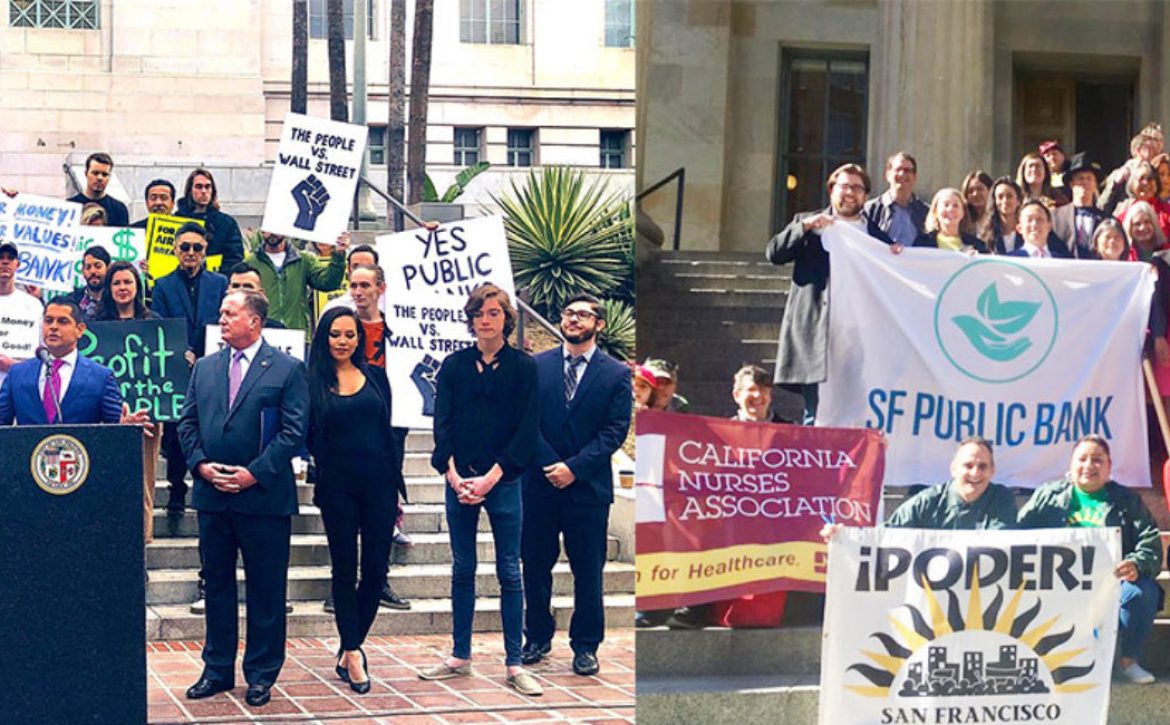
On Tuesday morning, the Los Angeles City Council passed a resolution introduced by LA City Council President Herb J. Wesson in support of AB 857 – a bill to give California cities and municipalities the option to start their own public bank. Arguing for the measure, City Council President Wesson had this to say:

“This morning’s vote is for the people that too long have been underbanked and overcharged. The reality is our financial system is not working for a large majority of people, in particular communities of color. A public banking system in our state is a much-needed first step to bring economic justice to California’s most disadvantaged communities.”

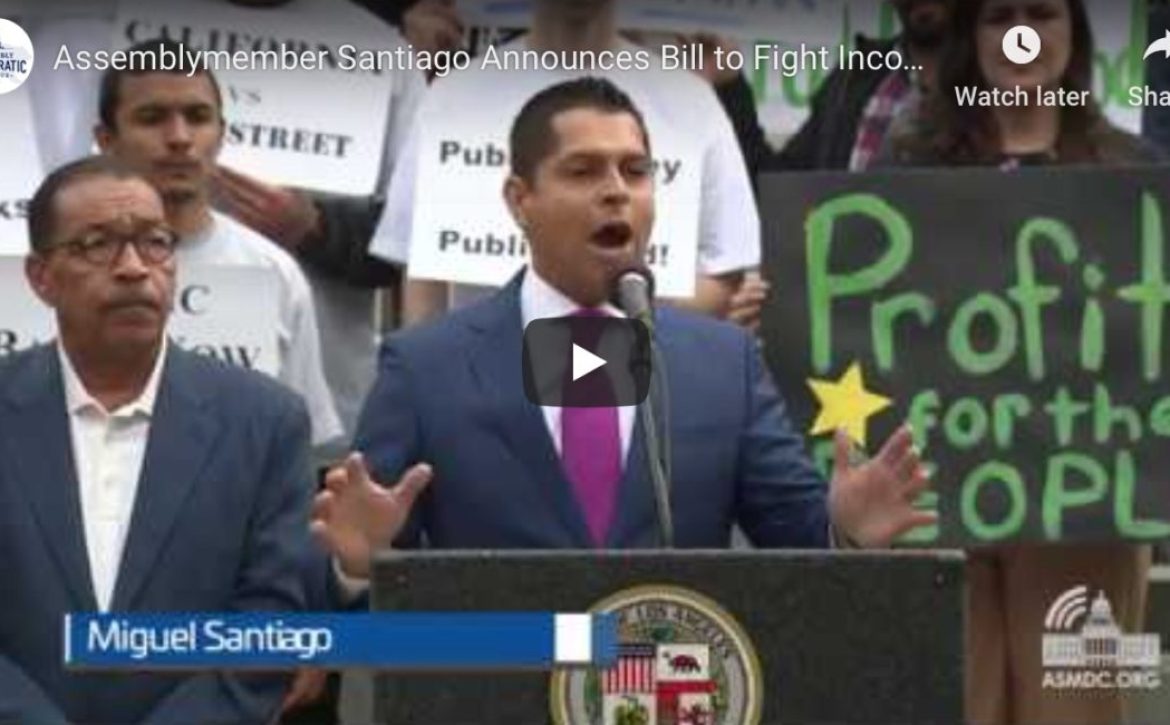
Assemblymember Miguel Santiago (D-Los Angeles), who is a joint-author of the Public Banking Act, responded, saying: “Californians from the grassroots to the halls of power are weary of a corporate banking system that doesn’t work for them. Wall Street needs people-powered competition, and a public bank for public good is the right place to start. Council President Herb Wesson has been a bold champion of public banks for many years, and I couldn’t be more grateful for his leadership and the support we’ve seen from so many others across the state.”

The City of San Francisco – home district of AB 857 joint author Assemblymember David Chiu (D-San Francisco) – will consider a substantively identical resolution in support of the bill this afternoon.

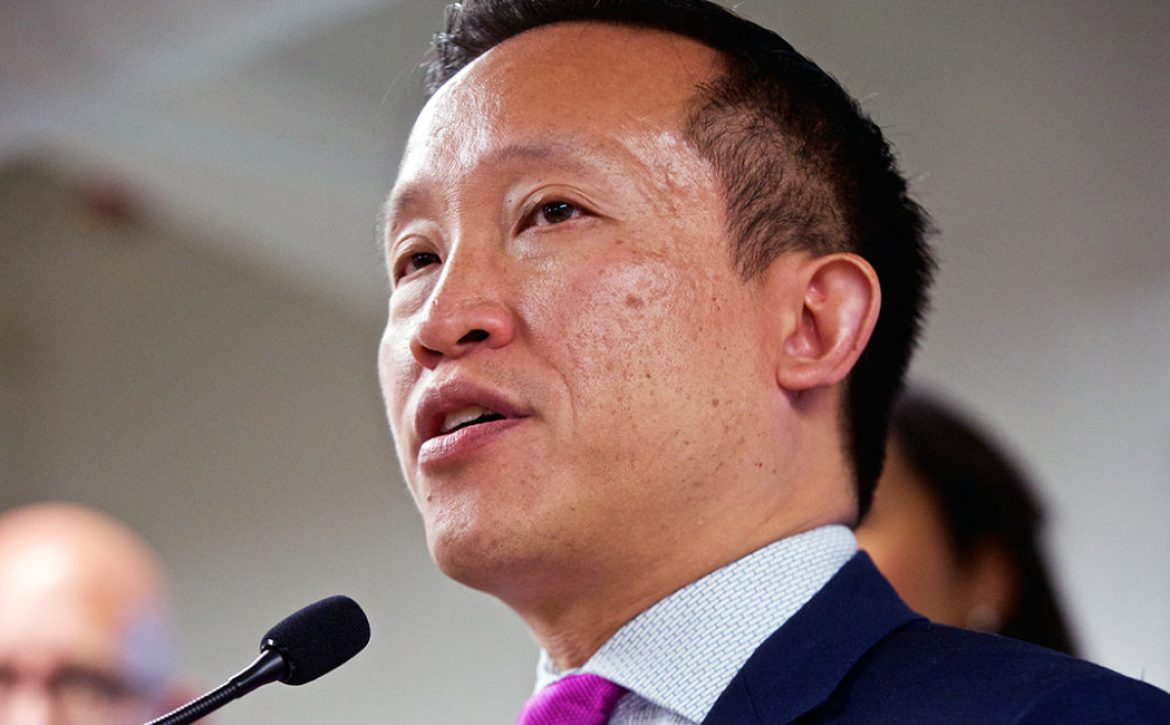
“The public’s money should serve a public purpose, not line the pockets of Wall Street investors,” said Assemblymember Chiu. “Time and time again, we have seen big banks invest billions of dollars of our money in institutions most Californians are opposed to. I am grateful to see such broad support for our efforts to reinvest the public’s money in our local communities.”

Trinity Tran, founding member of the California Public Banking Alliance said, “This is an unprecedented multi-city coordination among the biggest local governments, representing over 6 million people in the state of California. Wall Street Banks have proven that their interests are not aligned with California’s communities. Local governments have essentially been a captive market for mega-banks and now with this legislation, we have the opportunity to build a new alternative banking system through locally-controlled, socially and environmentally responsible public banks, enabling cities and counties to recapture public dollars and have a say over the financing of our own localities.”

Continue reading on Los Angeles Sentinel.

Read More
push

The Push for Public Banks

Today on Flashpoints: The push for a public bank in California. Trinity Tran and Sushil Jacob with the California Public Banking Alliance talks to KPFA’s Dennis J. Bernstein about the groundbreaking California State Assembly Bill AB 857, the growing public banking movement and why this is a pivotal moment for Californians. Interview starts at 21 minutes on the dial.

KPFA 94.1 – The Push for Public Banks

Read More
Screenshot 2024-11-20 at 2.46.44â€ŊPM

California cities could open their own banks under bill backed by Democratic lawmakers

Two California Democratic lawmakers have introduced a bill that would develop a state-owned banking system, modeling it on a program run by one of the smallest states in the union.

California Assemblymen Miguel Santiago, D-Los Angeles, and David Chiu, D-San Francisco, have introduced Assembly Bill 857, which would enable local governments to charter their own public banks.

North Dakota, with a population of fewer than 1 million people, has America’s only state-owned bank. The Bank of North Dakota this year is celebrating its centennial anniversary.

Santiago and Chiu would bring a similar system to California’s 39 million residents, arguing that a public institution might better serve the interest of low- and moderate-income households.

Continue reading on the Sacramento Bee.

Read More
statelegislation

State legislation could help pave the way for a public bank

Legislation introduced Monday could lay down the foundations for the creation of public banks in California and provide an alternative to San Francisco’s use of profit-driven commercial banks.

Currently there are no public banks in California, and no legal avenues to create one. But Assemblymembers David Chiu, D-San Francisco, and Miguel Santiago, D-Los Angeles, hope to change that with the introduction of Assembly Bill 857, which would allow jurisdictions to create public banks through a charter process.

The idea of a publicly-owned bank has gained traction in recent years as advocates and elected officials have called upon The City to divest its $11 billion budget out of commercial banks and into community centered projects that would better reflect San Francisco values.

“Wall Street banks have invested in oil pipelines, gun manufacturers, private prisons and companies with unfair labor practices,” Chiu said at a news conference Monday. “The opposite of what our state stands for.”

Continue reading on SF Examiner.

Read More
santiago

California Public Banking Alliance Press Release: Santiago and Chiu Introduce AB 857 to Pave Way for Public Banks

FOR IMMEDIATE RELEASE

Los Angeles, CA/San Francisco, March 11, 2019 – Asm. Miguel Santiago (D-Los Angeles) and Asm. David Chiu (D-San Francisco) held press conferences in their respective districts on Monday to introduce a new bill that will make it easier to establish regional and municipal public banks throughout the state of California.

The California Public Banking Alliance (CPBA) is sponsoring the legislation. CPBA designed the bill to provide localities a flexible framework for establishing public banks with appropriate terms, exceptions, and constraints.

“Public banking is one way we can start restoring economic power to our communities,” said Sushil Jacob, Senior Staff Attorney for Economic Justice with the Lawyers’ Committee for Civil Rights of the San Francisco Bay Area, one of CPBA’s founding members. “Wall Street banks routinely deny small business owners of color access to the credit they need to grow their businesses. When business owners of color do manage to get these loans, the fees and interest rates are often higher. These discriminatory patterns must end and the City can lead the way in providing an alternative.”

AB 857 will mobilize capital to take on the affordable housing goals that Assemblymembers Santiago and Chiu have already come together to champion.

“The public’s money should be used for public good.  Time and time again, we have seen big banks invest our money in institutions most Californians are opposed to–oil pipelines, gun manufacturers, private prisons, and companies with unfair labor practices.  This legislation allows us to take a first step towards ensuring the public’s money is reinvested in our local communities,” said Asm. David Chiu in a statement released this week.

Asm. Miguel Santiago released the following statement, “It’s pretty obvious that the Wall Street system of wealth distribution has created an income inequality crisis and nowhere is that more visible than right here in my district, where luxury condos loom over Skid Row. Instead of making rich men even richer, our resources should be invested in community development: parks and green spaces, free community college, new schools, smooth roads, and cleaner air. With AB 857 we’re laying the groundwork for a financial system that will give Californians access to capital they can afford, and empower communities to invest in projects that improve everyone’s quality of life.”

Around the country, as political discourse escalates on how to fund ambitious proposals for social equity and environmental justice, AB 857 may be one of the most important bills to watch.  This legislation will pave the way for reducing the cost of living in California.

“Wall Street Bank are financing climate destruction and they are doing it with our tax dollars,” said Doug Norlen, Director of the Economic and Policy Program at Friends of the Earth. “Public banks can invest our money into sustainable community projects right here in California instead of lining the pockets of Wall Street and Big Oil.”

CPBA is a coalition of grassroots public banking advocacy groups pushing for regional and municipally-owned public banks across California. Member groups include the San Francisco Public Bank Coalition, Public Bank Los Angeles, Public Bank East Bay, South Bay Progressive Alliance, Public Bank Santa Barbara, Public Bank San Diego, People for Public Banking Santa Cruz, Orange County Public Banking Coalition, and Friends of Public Banking Santa Rosa. Beneficial State Foundation, Friends of the Earth, and Lawyers’ Committee for Civil Rights of the San Francisco Bay Area are also members of CPBA.

Press Contact:
Sylvia Chi
sylviachi@gmail.com
(443) 977-4992
Read More
pay

This is how to pay for the Green New Deal.

Originally posted in Medium.

Dianne Feinstein, our Senator, had a viral moment on Friday, February 22, when a video circulated online of her lecturing Bay Area children about why she does not support the Green New Deal. The children were her constituents, on a visit to her office as part of an action coordinated with Sunrise Movement Bay Area, a youth-led climate movement. Sen. Feinstein told them, “There’s no way to pay for it,” and went on to detail how her decades of political experience informed her pessimism on the Green New Deal.

Sen. Feinstein presented the activists with a draft of her alternative resolution, which calls for the United States alone to eliminate greenhouse gas emissions by 2050, far short of the Intergovernmental Panel on Climate Change’s warning to limit global warming to 1.5°C. (Sen. Feinstein has since abandoned this resolution, and Senate Democrats have introduced a simpler “unity” resolution on climate change.)

In contrast, the Green New Deal proposal incorporates economic, industrial, and social justice policies to effect deep, systemic change to decarbonize the country in one decade. And as the name suggests, this type of massive transformation and government intervention has a precedent in the original New Deal, which rescued our country from the worst impacts of the Great Depression. As explained by economist Stephanie Kelton and others, the federal government paid for the New Deal’s massive public investments by exercising its financial sovereignty and creating credit via the Federal Reserve. Moreover, as public banking expert Ellen Brown has highlighted, during the New Deal, the federal government’s Reconstruction Finance Corporation (RFC) lent over $2.5 billion in agricultural loans, backed vast infrastructure investments, and re-stabilized the economy through emergency loans to states and for disaster relief.

The Green New Deal relies on a network of public banks — like a decentralized version of the RFC — as part of the plan to help finance the contemplated public investments. This approach has worked in Germany, where public banks have been integral in financing renewable energy installations and energy efficiency retrofits. And it’s an idea that has taken root in California: last November, over 430,000 Angelenos voted in favor of amending Los Angeles’ city charter as a first step towards a public bank, and Oakland, Berkeley, Richmond, and Alameda County have completed a favorable feasibility study. Sen. Feinstein’s own state director, Jim Lazarus, is a member of San Francisco’s Municipal Bank Task Force, which just completed a year’s worth of research into public banking and is presenting the San Francisco Board of Supervisors a range of public bank models to choose from. The Board — of which Sen. Feinstein used to be a member — recently unanimously passed a resolution in favor of the California Public Banking Alliance’s state legislation for a new charter that will allow cities and counties to establish their own public banks.

How will local or regional public banks help pay for the Green New Deal? They will make low-interest loans for building and upgrading infrastructure, deploying clean energy resources, transforming our food and transportation systems to be more sustainable and accessible, and other projects. The federal government can help by, for example, capitalizing public banks, setting environmental or social responsibility standards for loan programs, or tying tax incentives to participating in public bank loans.

Most importantly, as one of the young activists in the video pointed out, the cost of inaction (or insufficient action) far outweighs the cost of implementing a paradigm-shifting program like the Green New Deal. The Green New Deal’s job training, research and development, retrofitting and infrastructure investments, and technology deployment will stimulate and make our economy more resilient and better adapted for the more frequent wildfires, storms, and heat waves we face right now.

Sylvia Chi is a member of Public Bank East Bay and chair of the legislative committee of the California Public Banking Alliance.

Read More